You can’t watch a ballet performance, but you can admire one on your wrist
There are many things we miss nearly a pre-pandemic earth, and 1 of them is the ability to step into a concert hall to take hold of a musical performance, a theatre show, or a spellbinding ballet.
We may not be able to watch an enchanting alive ballet performance these days, but you tin can all the same capture its essence on your wrist, courtesy of Van Cleef & Arpels' exquisite trio of Lady Arpels Ballerines Musicales timepieces.
But first, why did Van Cleef & Arpels determine to showcase ballet on a watch? The bond between jeweller-watchmaker and art class dates to the 1920s, when Louis Arpels, blood brother of co-founder Estelle Arpels and a fervent ballet lover, would take his nephew Claude to the Opera Garnier in Paris.
This kinship with the world of ballet deepened in the 1950s, when Claude Arpels fabricated the acquaintance of famed choreographer George Balanchine, co-founder of the New York Metropolis Ballet. Their shared passion for gems blossomed into an creative bond that produced Balanchine's ballet Jewels, first performed in New York in April 1967.
Every act of the non-narrative triptych linked a gemstone to a musical composer: Gabriel Faure for Emeralds, Igor Stravinsky for Rubies and Pyotr Ilyich Tchaikovsky for Diamonds.
To capture the dazzler of Balanchine's masterpiece, Van Cleef & Arpels placed each act on the wrist with a trio of masterpieces. Precious stone-setting, enamel painting and mechanical watchmaking combine to create an enchanting celebration of the ballet, where no detail is spared.
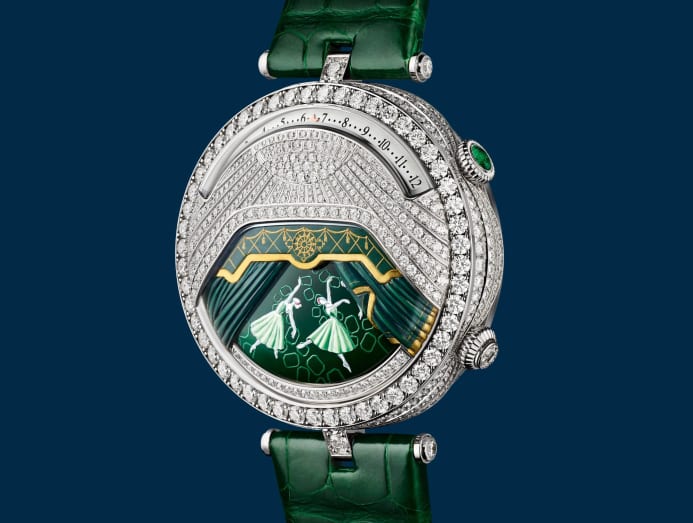
The Lady Arpels Ballerines Musicales Emeraude sentry displays light-green nuances, while the Lady Arpels Ballerines Musicales Rubis timepiece shines in elegant cherry-red tones.
The Lady Arpels Ballerines Musicales Diamant spotter sparkles with intense white, blue and gilded hues.
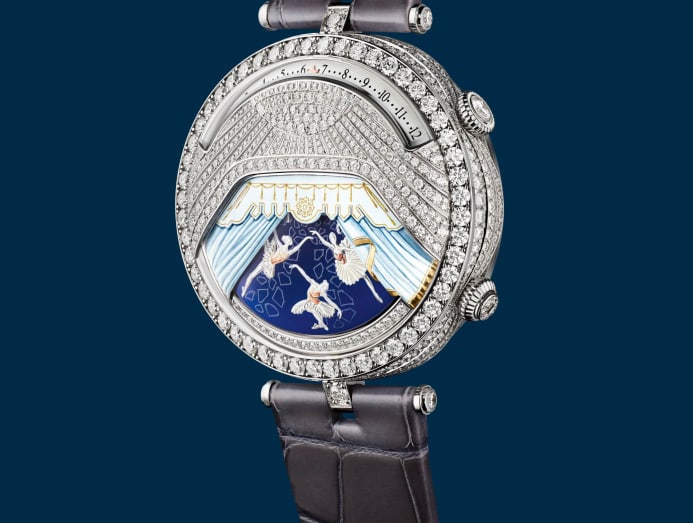
The dial of the timepiece is designed to represent a performance phase. The diamond pave on the upper dial is akin to a chandelier lavishly cascading over the stage. At the touch of a button, the hand-painted draperies on the lower dial part to reveal ethereal ballerinas in miniature painting.

Music even emerges through the diamonds on the timepiece, transporting the wearer into a live performance infinite, where ballerinas dance before the eyes.
The melody is the effect of combining a music box with a mechanical carillon minute repeater function. Together, they are able to play on-demand music synchronised with the ballerina movement.
The timepieces have a 52-hour ability reserve, and are manually wound. On the case back, the jeweller-watchmaker has designed an engraved bas-relief illustration portraying a ballerina dancing in front of the Van Cleef & Arpels 5th Avenue boutique in New York, where Claude Arpels hosted George Balanchine in 1966 for a private viewing of the firm's creations.
With such an elaborate dial, how then, can one tell the time? A star, tucked discreetly at the elevation of the punch, moves across a retrograde hours scale between 10 o'clock and 2 o'clock. The dots between the numerals correspond 20-minute intervals between each hr.

But with such captivating artistry on the sentry, we think that telling time is well-nigh irrelevant – you lot'd be as well caught upwards admiring the dazzler of the ballet.
READ> A planetarium on the wrist: What'southward the betoken of pointless lookout man complications?
Source: https://cnalifestyle.channelnewsasia.com/obsessions/van-cleef-and-arpels-lady-arpels-ballerines-musicales-235526

Post a Comment for "You can’t watch a ballet performance, but you can admire one on your wrist"